
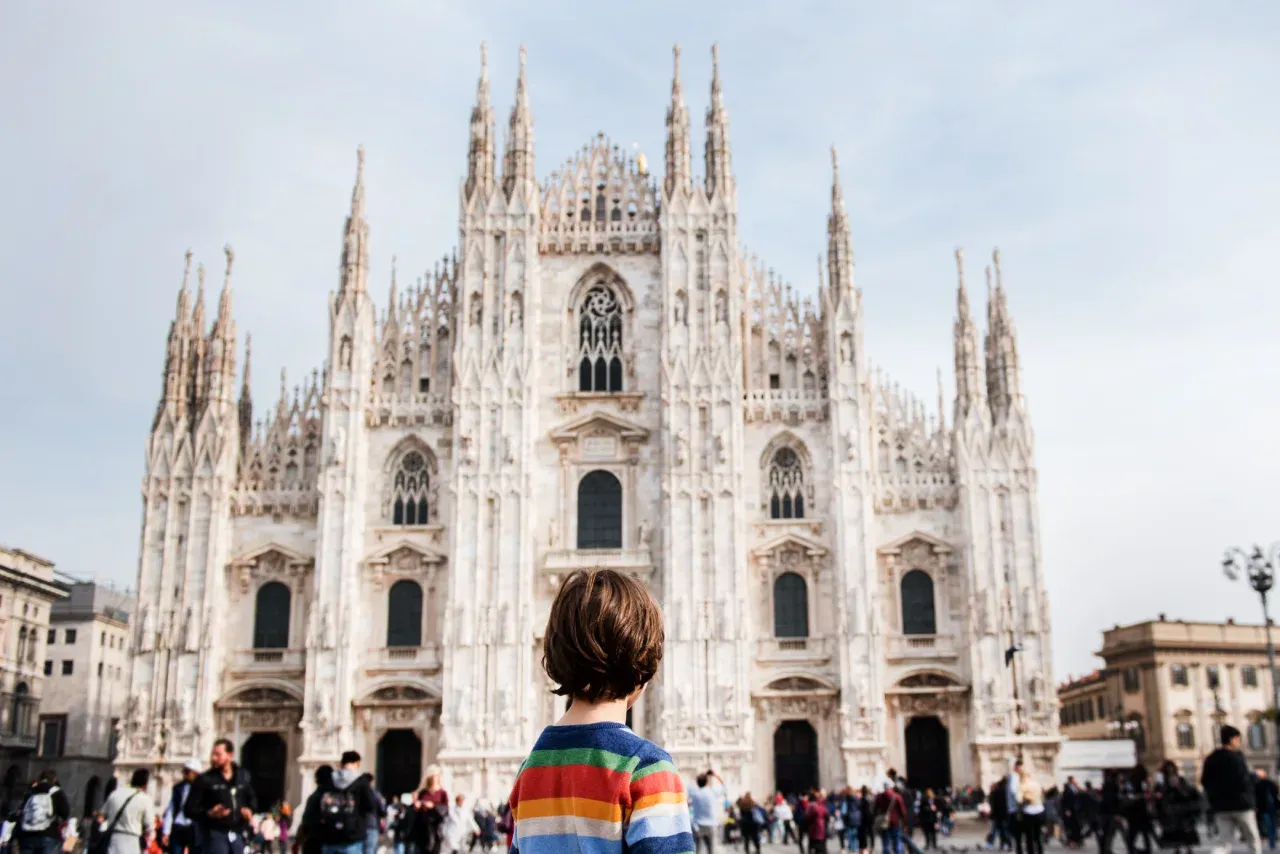
Dress code at Duomo Milan
The dress code at Duomo Milan is a strict entry requirement mandating that all visitors cover their shoulders and knees while inside the cathedral. Security personnel enforce these regulations by denying access to individuals wearing sleeveless tops, short shorts, mini-skirts, or hats. Compliance is compulsory for men, women, and children to ensure admission.
Opening hours
The cathedral open daily from 9:00 AM to 7:00 PM, while the rooftops and museum follow specific schedules.
Location
The cathedral is situated in Piazza del Duomo at the city's geographic center.
Estimated visit time
A tour of the cathedral, archaeological area, and rooftops takes 1.5 to 4 hours, or up to 4 hours if including the museum.
How strict is the Duomo Milan dress code?
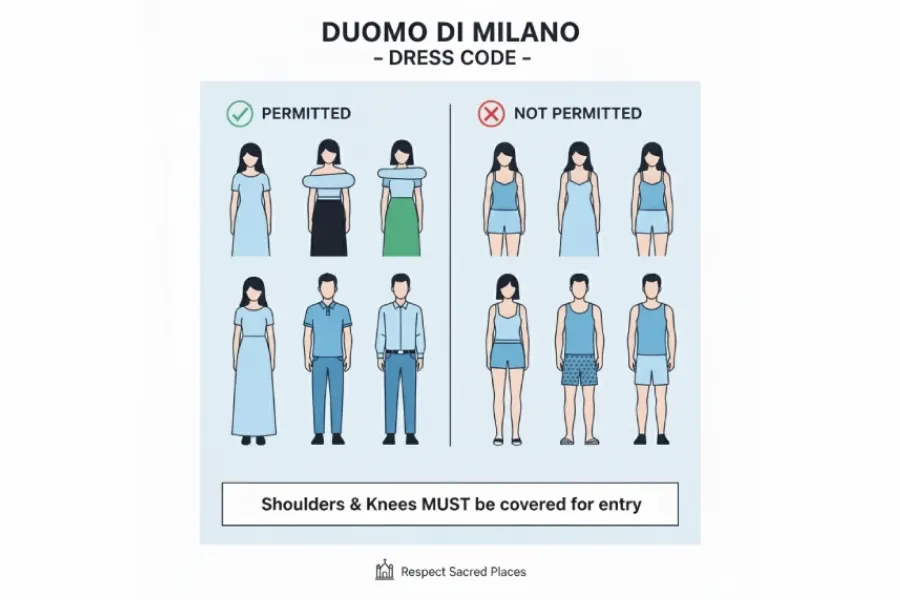
How strict is the Duomo Milan dress code?
The dress code at Milan’s Duomo is strictly enforced, especially for the Cathedral interior. Security personnel stand at the entrance specifically to check that visitors are dressed modestly, and they won’t hesitate to turn you away if you’re not.
The core rule is simple: shoulders and knees must be covered at all times for both men and women inside the Cathedral. That means no sleeveless tops, no shorts above the knee, and no beachwear.
Rules aren’t quite as strict on the rooftop terraces and in the museum areas. Many visitors say “for terraces anything goes,” meaning you can dress more casually if you’re only visiting the rooftop. But here’s the catch: if your ticket includes the Cathedral (and most do), you need to dress for the stricter code from the start. You can’t just change outfits halfway through your visit.
Things that the dress code does not allow you to wear
What about showing knees as a man?
The Duomo Milan dress code mandates that men cover their knees to gain entry. Security personnel enforce the “no-knees-showing” rule equally for male and female visitors. Guards frequently deny access to men wearing shorts that end above the knee. So, male visitors must wear trousers, jeans, or long shorts that extend clearly below the kneecap to comply with Cathedral regulations.
Can you wear sandals?
Veneranda Fabbrica del Duomo di Milano generally permits standard walking sandals within the Cathedral. Official guidelines discourage rubber beach flip-flops or open-toe shoes primarily for safety reasons. Security staff rarely refuse entry based on substantial sandals. Visitors should prioritize footwear with grip. The Duomo features smooth marble floors and Rooftop stairs that become slippery, creating a hazard for unstable shoes.
Normal sandals are generally tolerated. Travel forum note that “no worries about sandals… I’ve never seen a single report from a visitor turned away for wearing those.”
Is there a dress code to climb to the rooftop?
Duomo’s Rooftop requires the same modest attire as the Cathedral interior. Visitors possessing a combined ticket for both the church and the Terraces must adhere to strict modesty rules regarding covered shoulders and knees. Athletic wear or gym clothes usually fail to meet these standards. Safety remains a priority on the Terraces. The staircases are narrow, steep, and constructed of marble, requiring stable, non-slip footwear rather than aesthetic beach shoes.
Can you change your outfit once inside?
No, don’t even think about it. The dress code isn’t a checkbox you tick at the entrance and then forget about. It’s about respecting the sacred space for the entire duration of your visit.
Smart outfit choices for both the cathedral and exploring Milan
What to wear in summer without breaking the rules
Milan in summer can be brutally hot. We’re talking 30°C+ in July and August. The thought of covering up might sound uncomfortable, but you can absolutely beat the heat while meeting the dress code.
- For women, a flowy maxi dress made of cotton or linen is your best friend. It covers shoulders (if it has sleeves or you add a light shawl) and goes past your knees while still being incredibly breezy. A midi skirt paired with a short-sleeve blouse works beautifully too. Look for breathable fabrics like cotton, linen, or rayon. Palazzo pants or loose linen trousers are another great option—they’re airy but cover your legs completely. Light colors will help you stay cooler under that Italian sun.
- For men, linen or lightweight cotton shirts (with at least short sleeves) and linen trousers or chinos are the way to go. These fabrics are so much cooler than heavy denim. Consider convertible travel pants (the kind that zip off into shorts), but remember to zip the lower legs back on before entering the Duomo so your knees are covered. Long shorts that truly reach below the knee—some styles fall to mid-calf—are airy and acceptable too.
Where else in Milan is there a dress code?
Milan’s Duomo isn’t the only place in the city (or Italy) where you should be mindful of how you dress. As a traveler, it’s useful to know that most religious sites have similar rules.
Here’s a quick rundown of where else to keep that shawl handy:
- Other Milan churches: This applies to other beautiful churches in the city, like the Basilica di Sant’Ambrogio or Santa Maria delle Grazie. Enforcement might not be as strict as the Duomo, but the etiquette is the same, especially if a service is in progress.
- The Last Supper (Cenacolo Vinciano): This one is a special case. Since you’re viewing the painting in a refectory (an art site), there isn’t a strict dress code enforced just to see the artwork. However, it’s attached to the church. If you plan to pop into the Santa Maria delle Grazie church itself, you’ll need to cover up.
- About major italian basilicas, think of the Duomo’s rules as your practice run. Major sites like St. Peter’s Basilica in the Vatican are famously strict—they will absolutely turn you away. The same applies to the main cathedrals in Florence and Venice.
- The good news (secular sites): Here’s where you can relax. Museums, castles, and theaters have no dress code. Feel free to wear your shorts and tank tops when visiting places like the Castello Sforzesco, the Museo del Novecento, or La Scala. The code is only for religious sites.